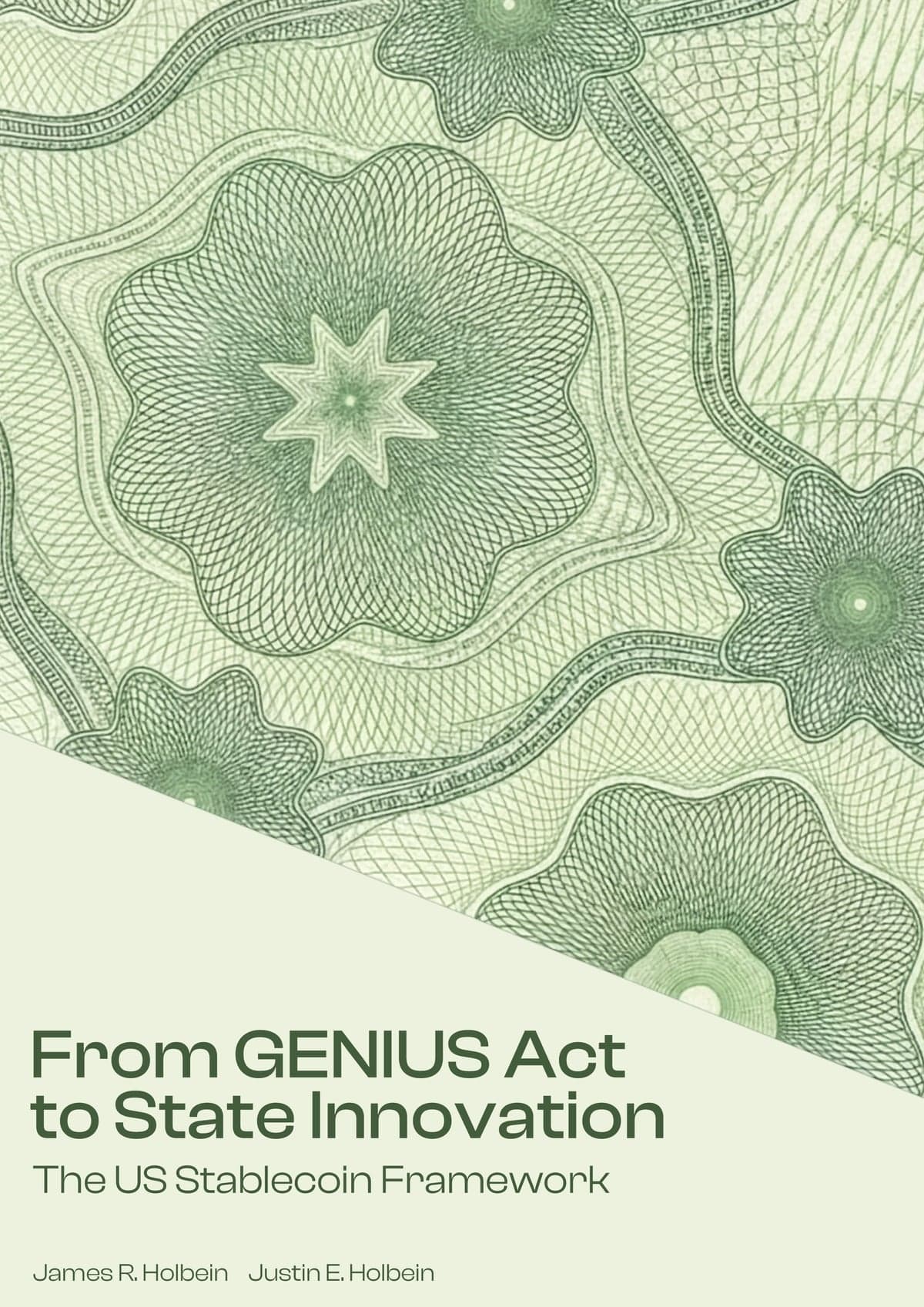
From GENIUS Act to State Innovation: The U.S. Stablecoin Framework — book cover

From GENIUS Act to State Innovation

The U.S. Stablecoin Framework

By James R. Holbein & Justin E. Holbein

Written during the rulemaking window rather than after the dust settled, this book gives compliance officers, counsel, founders, and policymakers a working map of where U.S. payment stablecoin regulation actually stands, and where it is heading. Twenty-one chapters on the GENIUS Act, the 2026 agency rulemakings, the state programs, DUNA governance, and x402 payments.

$39

Early bird price · $49 regular

PDF & EPUB delivered instantly after purchase. Kindle & paperback coming soon on Amazon.

$312BStablecoin Market
21Chapters
345Pages
6Appendices

Twenty-one chapters, from statute to implementation.

Part I

Foundations

What stablecoins are, how they evolved from Tether to today's $312 billion market, and why they matter for the future of money.

  1. 1Introduction
  2. 2Understanding Stablecoins
Part II

Federal Framework

A line-by-line breakdown of the GENIUS Act — reserve requirements, customer protections, issuer obligations, and compliance timelines.

  1. 3The GENIUS Act
  2. 4Federal Regulatory Implementation
  3. 5Reserve Requirements and Compliance
  4. 6Customer Protection and Interoperability
Part III

State Innovation

Wyoming's pioneering SPDI model, the FRNT stablecoin launch, and how state regimes qualify alongside the federal framework under the GENIUS Act's certification pathway.

  1. 7Wyoming's Crypto-Friendly Legal Framework
  2. 8The Wyoming Stable Token Act
  3. 9FRNT Launch: America's First State-Issued Stablecoin
  4. 10State Stablecoin Federalism
  5. 11Other States: New York, Nebraska, North Dakota, and the Emerging Landscape
Part IV

DAO Governance

The DUNA framework for decentralized governance — legal structure, practical adoption strategies, and real-world case studies.

  1. 12Wyoming's DUNA Framework: Legal Structure for Non-Profit DAOs
  2. 13DUNA in Practice: Adoption Status and Case Studies
  3. 14Integrating DAOs with Stablecoin Ecosystems
Part V

Machine Payments

The x402 payment protocol, AI agent economics, and how stablecoins become the default rails for autonomous machine-to-machine commerce.

  1. 15x402: The Internet-Native Payment Protocol
  2. 16x402 V2: Technical Evolution and New Capabilities
  3. 17AI Agents and Autonomous Payments
  4. 18Regulatory Considerations for Payment Protocols
Part VI

Practitioner's Guide

Your compliance roadmap: step-by-step integration playbooks, risk frameworks, and strategic guidance for what comes next.

  1. 19Compliance Roadmap for Stablecoin Issuers
  2. 20Integrating Regulated Stablecoins: A Business Guide
  3. 21The Road Ahead
Reference

Appendices

  • AGENIUS Act Key Provisions Summary
  • BWyoming Stable Token Act Summary
  • CDUNA Formation Checklist
  • Dx402 Technical Implementation Guide
  • ERegulatory Timeline and Deadlines
  • FGENIUS Act Agency Rulemakings

Written for the people who have to act on the GENIUS Act.

Compliance officers and in-house counsel
At issuers, custodians, exchanges, banks, and fintech platforms — what the GENIUS Act actually requires and how state frameworks interact with it.Start with: Parts II, III, and VI, with Appendix F as a fast reference to the 2026 agency rulemakings.
Outside counsel
Advising on payment stablecoin issuance, state versus federal pathways, custody structures, AML and sanctions obligations, and payment-protocol questions.Start with: Parts II through VI, plus Appendices A and F — the densest legal material.
Founders, operators, and product leaders
Building stablecoin issuers, custody infrastructure, payment protocols, AI-agent platforms, or DAO-governed projects.Start with: Parts IV through VI, plus the DUNA formation checklist (Appendix C) and the x402 technical guide (Appendix D).
Policymakers and agency staff
Working on implementation, market-structure legislation, and the gaps the GENIUS Act left for future work.Start with: Chapters 3–6, 10, 18, and 21.
Investors, analysts, and journalists
Which issuers operate under which authorities, which states are emerging as crypto-friendly, and how regulated stablecoins differ from the prior generation.Start with: Chapters 1, 2, 9, and 11.
Students, academics, and curious readers
A single-volume treatment of where U.S. digital-payment regulation stands at the start of the GENIUS Act era.Start with: Part I, then any topic of interest.

The complete reference.

Early Bird
$39 (save $10)
Regular Price
$49
Formats
PDF, EPUB (Kindle & paperback coming)
Published
July 2026 · First Edition
Length
345 pages

About the book and the GENIUS Act.

What is the GENIUS Act?
The Guiding and Establishing National Innovation for U.S. Stablecoins Act (Public Law 119-27), signed on July 18, 2025, is the first federal framework for payment stablecoins in the United States. It defines who may issue a payment stablecoin, how reserves must be held, what protections customers receive, and how state regimes can qualify alongside federal supervision. Part II of the book covers the Act in detail.
How current is the book?
This is the First Edition, published July 2026. The substantive cutoff is April 22, 2026: the book covers the GENIUS Act as enacted on July 18, 2025, and the agency proposed rules and joint interpretive notices published through that date. It was written during the rulemaking window on purpose, so it shows what regulators are debating before final rules lock in. Final rules are expected through 2026 and 2027 and may differ from the proposals. Appendix F surveys each 2026 federal rulemaking, and Appendix E sets out the regulatory timeline and deadlines.
Does the book take a position on the GENIUS Act?
No. The authors have views, and they come through in the analysis. The book's purpose is to lay out what exists and what it means. It does not argue for or against the GENIUS Act, any state framework, or stablecoins as a category. It is also not a step-by-step manual for issuing a stablecoin. Chapter 21 discusses what is plausibly coming, and the book treats prediction as separate from analysis.
Which states does the book cover?
Wyoming receives the deepest treatment: its digital asset statutes, the Stable Token Act, and the launch of FRNT, the first state-issued stablecoin. The book also surveys New York, Nebraska, North Dakota, and Texas, and explains how state regimes interact with the federal framework.
Is this book legal advice?
No. The book provides general information about U.S. stablecoin law and policy. James R. Holbein is a licensed attorney; Justin E. Holbein is a blockchain subject-matter expert and is not an attorney. Reading the book does not create an attorney-client relationship. For guidance on a specific situation, contact the authors through American Digital Asset Consulting.
How is this different from law-firm client alerts on the GENIUS Act?
A client alert summarizes one development. This book connects the statute, the implementing rulemakings, state stablecoin programs, DAO governance under Wyoming's DUNA law, and the x402 payment protocol in one reference, and ends with a compliance roadmap for issuers and an integration guide for businesses.
What formats are available?
PDF and EPUB are available direct, delivered instantly after purchase. Kindle & paperback coming soon on Amazon.
What is the refund policy?
Digital files that are defective or not as described are refundable within 14 days of delivery. The full terms are on the Refund Policy page.

More questions? Contact the authors or read the refund policy.

Ready to navigate the new stablecoin landscape?

$39

Early bird price · $49 regular

PDF & EPUB delivered instantly after purchase. Kindle & paperback coming soon on Amazon.

The first in a series.

Coming Soon

The CLARITY Act

Market structure for digital assets

Coming Soon

DUNA in Practice

Decentralized governance, legally grounded